English| EUR
Suggested for you
More currencies
Choose a language
The descent from Masca village to the Atlantic is short in kilometres and long in consequence. This Masca Gorge trail difficulty guide explains what the terrain actually asks of a walker: the surface underfoot, the one-way commitment and the weather that changes the grade. It also sets out how the booking window and shuttle timetable shape how hard the day feels.
Quick answer
Masca Gorge trail difficulty is best described as demanding rather than technical: a continuous one-way descent over loose rock, boulders and dry riverbed, with helmets required and almost no shade. Access is capped, booked in advance for a 3 EUR conservation fee, and all arrivals fall between 07:00 and 14:00. Rain in the catchment can suspend the route at short notice.
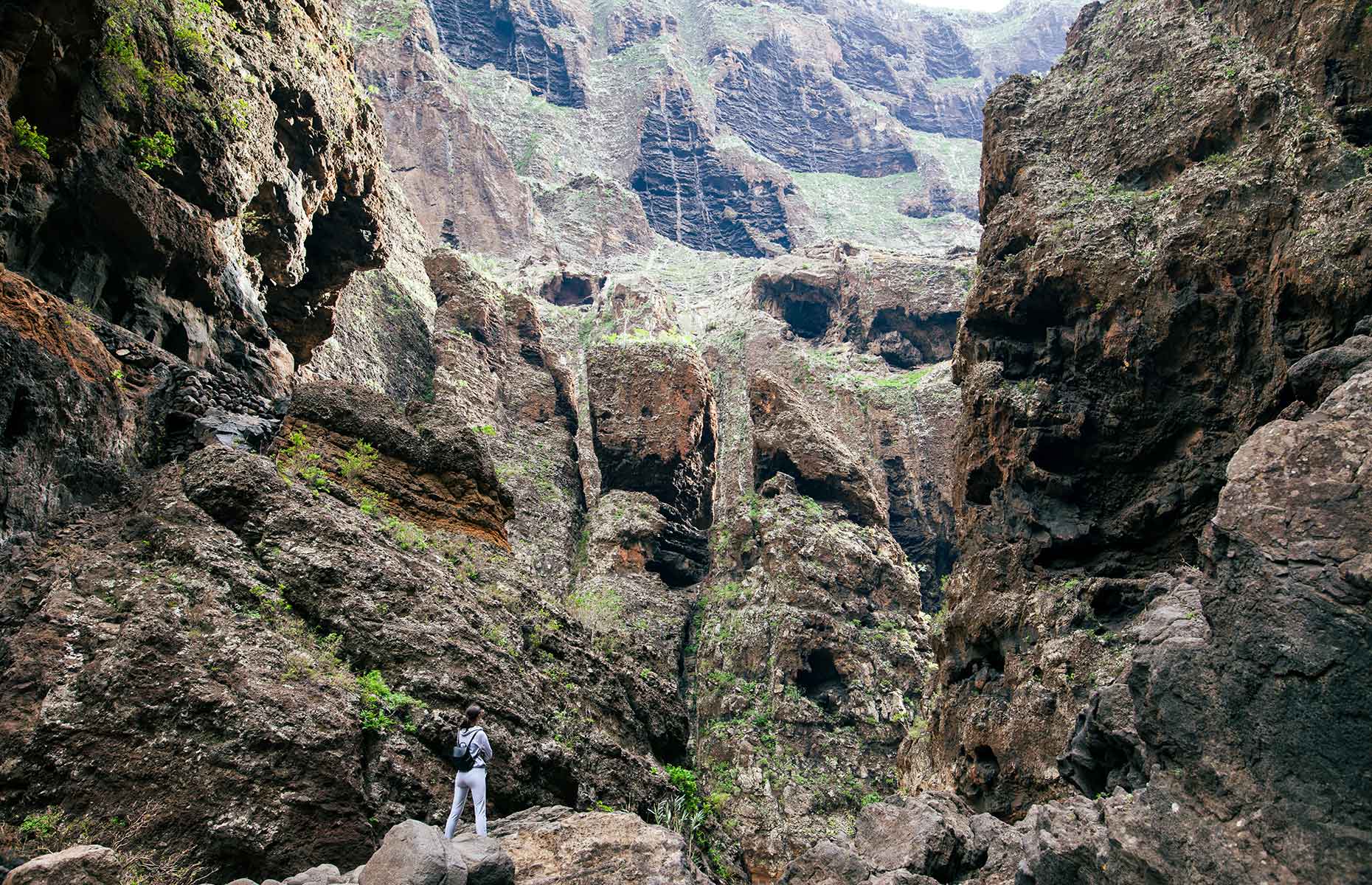
The Barranco de Masca was closed to walkers for nearly three years and reopened in 2021 as one of the most tightly managed footpaths in the Canary Islands. Nothing about that decision was cosmetic. Visitors now descend under a booked headcount, wearing a helmet, on a route that has been surveyed, marked and partly rebuilt. Understanding Masca Gorge trail difficulty starts there: the ravine is not hard because it is long, but because it is committing. Once a walker passes the upper checkpoint above Caserío de Masca, the only realistic exits are the sea at the bottom or a long reclimb of everything already descended. The gorge decides the terms. The walker simply agrees to them. Grading systems disagree about the gorge because it fails to fit them. The distance is modest by mountain standards and the elevation loss is continuous rather than punishing. What raises the rating is surface: water-polished basalt, dry riverbed, loose scree between boulder steps, and short scrambles where hands come off the poles and onto rock. The walls narrow to a corridor of dark volcanic stone that traps heat through the middle of the day, and shade disappears entirely in the lower ravine. Canarian palms and the occasional dragon tree mark the route, but there is no bail-out path, no road crossing, no water point. Signage is sparse once the walls close in, and mobile coverage comes and goes with the bends of the barranco. Rangers at Teno Rural Park manage flow accordingly, and rain anywhere in the catchment above can suspend descent at short notice. Anyone comparing the barranco de Masca hike with the coastal walks near Los Gigantes is comparing different categories of outing. The relevant question is not fitness alone but tolerance for uneven ground, exposure to sun and a fixed timetable that ends at the shore, where a boat transfer to Los Gigantes replaces the road that does not exist. That structure explains why difficulty here is inseparable from timing. Access to the Masca Gorge hike is governed by a mandatory shuttle bus and an arrival window of 07:00 to 14:00, and the ravine does not open every day of the week. A walker who books the last permitted slot inherits the hottest, busiest and least forgiving version of the same route; one who starts at first light meets cool stone, quiet narrows and a comfortable margin before the boat schedule tightens. Reservations run through the official trail authority at caminobarrancodemasca.com, and the descent begins at Caserío de Masca, above Buenavista del Norte. Read the itinerary breakdown for pacing, the kit list for footwear and the common-errors section before fixing a date. Judged honestly, Masca Gorge trail difficulty is manageable for a steady, unhurried walker with sound ankles and an early booking, and unmanageable for anyone treating a protected barranco as a casual afternoon stroll. Summer visitors in particular should treat August heat as part of the grade rather than a detail attached to it. The gorge does not reward improvisation. It rewards planning, and it quietly punishes the assumption that a walk which goes downhill must therefore be an easy one.
“The ravine is not hard because it is long, but because it is committing.”
This plan suits reasonably fit walkers comfortable with sustained uneven descent, loose rock and repeated stream crossings, walking the gorge one way from Masca hamlet to Masca beach. Allow around five to six hours door to door, of which roughly three to four are walking time.
Register at the trailhead in Caserío de Masca and begin the descent from roughly 600 m. The first 20 minutes of stepped, stone-paved switchbacks set the pace for the whole walk.
The path drops into the barranco floor and the surface changes from steps to loose boulders and gravel. Expect to slow to about 2 km/h here, using hands on the larger rock shelves.
The narrowest section between the vertical walls requires short scrambles and repeated crossings of the streambed. This is the most physically demanding stretch and where most walkers lose time, so budget an extra 30 minutes.
The valley opens out and the gradient eases, but the ground stays stony and ankle-turning. Legs are usually tired by this point, so shorten your stride rather than pushing pace.
The trail ends at the pebble cove at sea level, around 4.5 km and 600 m of descent from the start. Rest here before your return, since there is no road exit on foot.
Departure from the beach is by boat to Los Gigantes, so plan your arrival with slack rather than sprinting the last section. Walkers who choose to hike back up should double their descent time and reassess their energy honestly.
The gorge floor is loose rock, water crossings and steep descent, so gear choice does more for your comfort than fitness alone.
Most difficulty misjudgements at Masca come from reading the 5.6 km distance and ignoring the 600 m of descent packed into it. The errors below are the ones that turn a manageable walk into a rescue call.
Judging the route by distance rather than descent
Plan around the sustained drop through the barranco, not the kilometre count. Treat it as a knee-loading descent that takes most walkers three to five hours, and set your turnaround expectations from that.
Starting fast on the easy upper section
Hold a slow, even pace from the first switchbacks. The gradient steepens lower down where the rock is polished and loose, and legs burned out early are the main cause of slips.
Descending on unstable footing without using hands
Slow down on wet or polished rock and use rock holds on the steeper scrambling steps. Keep both hands free rather than carrying items loose, and do not step onto boulders in the streambed that look dry but hold algae.
Ignoring the fixed daily cut-off when pacing
Track your time against the last permitted entry window of 07:00–14:00 and factor in that the gorge is one-way to the coast. Turning back uphill is far harder than continuing.
Attempting the gorge with unresolved knee, ankle or heart issues
Be honest about existing joint or cardiac limits before booking, since the descent offers no shortcut exits once you commit. Consult your doctor if in doubt.
Splitting from your group in the narrow sections
Stay within sight of your companions throughout. Phone signal is intermittent between the rock walls, and a lone walker with a twisted ankle may wait a long time before anyone passes.
The Masca Gorge trail operates on a set weekly schedule and requires advanced planning for access. Trail entry is permitted only during these designated operating hours.
Everything you need to know about masca gorge trail difficulty
The trail is physically demanding, involving significant elevation changes and rugged terrain. Assess your fitness level before attempting this challenging canyon descent.
Navigating the Barranco de Masca involves steep gradients and rocky paths that test your endurance. Proper preparation is essential for this protected natural landscape.
Given the intense terrain, the masca gorge trail difficulty is classified as high and requires good physical condition. Hikers should be comfortable with long descents and steep return climbs.
This trail is not recommended for young children or individuals who are not accustomed to strenuous physical activity. Strict safety regulations apply to ensure the protection of all participants.
Access requires a conservation fee of 3 EUR per person, which must be booked in advance via the official website. This fee supports the maintenance and protection of the trail.
Due to the physical intensity, the best arrival window is 07:00–14:00 to ensure enough daylight for the descent and ascent. Planning your start within these hours helps manage the masca gorge trail difficulty throughout your hike.